GENERAL ARTWORK REQUIREMENTS
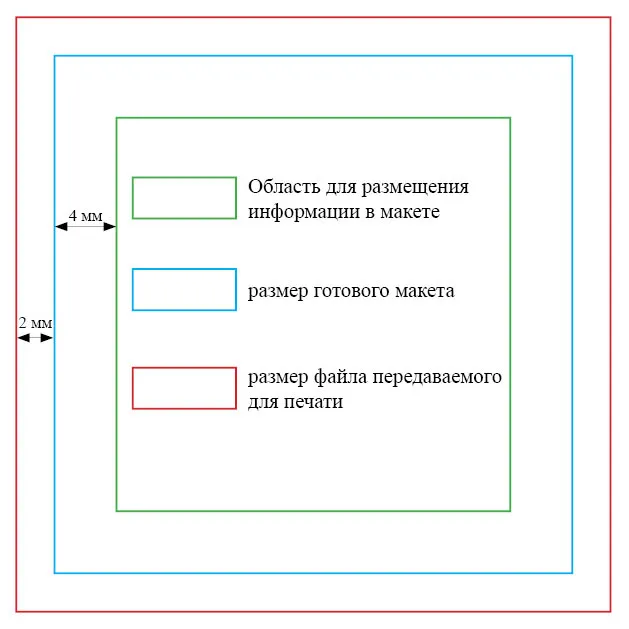
Colour model: CMYK Resolution of raster images: at least 300dpi Vector files: fonts converted to curves File formats: pdf, eps, indd (up to CS4 version), tif, jpg Dimensions of the supplied file: must exactly match the size of the finished printed product + 2 mm bleed on each side.
BUSINESS CARD ARTWORK REQUIREMENTS
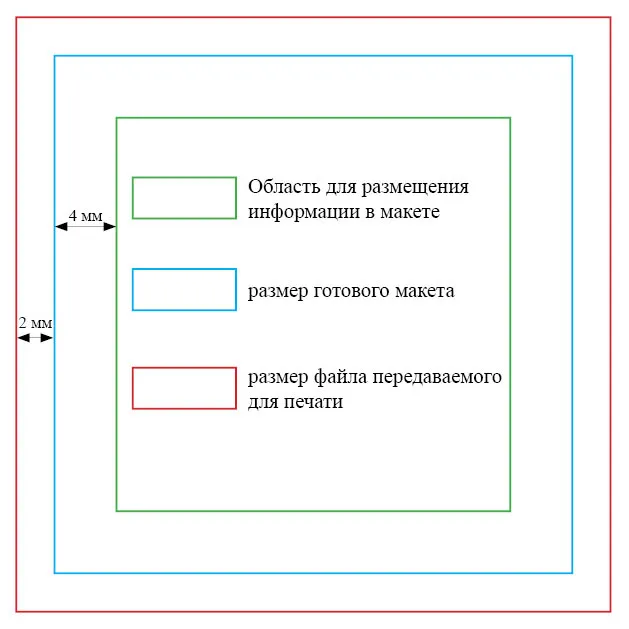
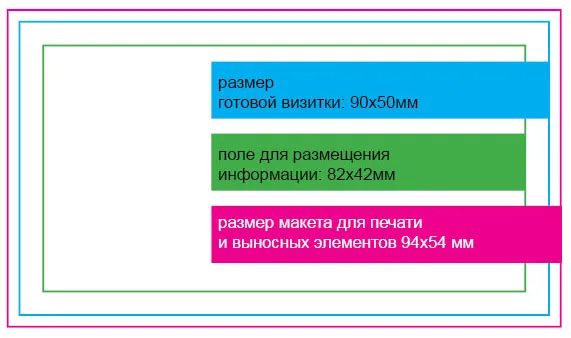
The dimensions of the supplied artwork must exactly match the finished product + 2 mm bleed on all sides. Below are the layout schemes for preparing artwork for printing. Finished business card size: 90x50mm information placement area: 82x42mm artwork size for printing including bleed: 94x54 mm.
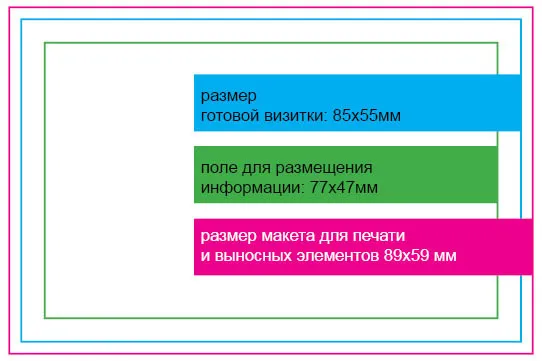
Finished business card size: 85x55mm information placement area: 77x47mm artwork size for printing including bleed: 89x59 mm.
Printing services
The process of producing printed materials can be roughly divided into three parts: preparing the electronic version of the artwork, the printing itself, and the post-press processes.
Preparing the electronic version of the artwork.
General description.
The artwork is created in specialised software and is divided into several stages. Raster images are created or edited in Photoshop, vector images in Illustrator, Corel. Layout and final pre-press preparation is done in InDesign, QuarkXPress. Certain requirements apply to the files: resolution (measured in dots per inch — the DPI parameter, which must be at least 300 for offset and digital printing; 70-100 for large-format), colour, technological marks, and additional files may also be required for die-cutting, embossing and other post-press processes.
It is also worth noting that the font files must be supplied to the designer together with the artwork, in case changes need to be made to the artwork. File saving formats.
For printing.
The file for printing is, as a rule, saved in .pdf format. Before creating this file, intermediate files may be produced — these can be either vector or raster images.
Raster images.
Raster images are formed by describing each individual point. Raster formats are generally used to store photographs and scanned images, and may also include computer-created illustrations. They are mostly saved in the .tiff format.
Vector images.
Vector images are formed by describing the paths between points, which makes the files much smaller in size compared with raster images. Vector graphics are used to create logos and various illustrations. One of the advantages is that an image can be enlarged without loss of quality. The recommended file saving format is .ai, .eps.
Colour requirements.
It is worth noting that images obtained from digital cameras and scanners are formed in the RGB colour model (red, green, blue), just like the image on a monitor.
Files for printing must be in four colours: cyan, yellow, magenta and black — abbreviated in English as CMYK — Cyan, Magenta, Yellow, K-black, where K stands for the key, black colour.
The RGB colour model displays a greater number of colours than the CMYK model; this is because in RGB colour is formed by emitted light, whereas CMYK was created for printing on materials, meaning colour is formed by reflected light. Additionally, in printing (offset, screen printing) spot colours (Pantones) may be used in cases where it is necessary to achieve a colour that cannot be reproduced in the CMYK model.
Taking the above into account, it should be borne in mind that the image displayed on the monitor differs from the one produced after printing. Hence there are heightened requirements for monitor quality and colour calibration.
About design in general
In this case, design can refer to developing a logo, designing a business card, designing a book or magazine cover, and so on. But in order to draw clearer distinctions between concepts and the complexities involved in creating the electronic version of the artwork, we will use the wording that, in our view, is more suitable for the everyday interaction between the customer and the printing house (a subjective view, of course — but nevertheless).
About types of design
The development and creation of artwork for printed products can be roughly divided into several types and levels of complexity. For example, the most complex is developing a corporate identity, a logo, the style of a periodical from scratch, or packaging. The simplest involve reproducing an existing design, simple advertising and presentation materials such as business cards, letterheads and signage.
About forms of working on design
Work on the design can be carried out in different forms:
first — the customer, when ordering a particular product, can fully entrust the designer with how the product will look; second — the designer develops three to five variants, from which the customer chooses one, and this variant is refined taking into account the customer's wishes (as a rule, the number of such revisions is no more than three — otherwise the design price is reconsidered to account for the time spent); third — work on the design is carried out in the customer's presence, with as many variants and revisions created as are necessary for the customer's approval (this option is the most expensive and, as a rule, the cost is stated after the work is completed). The cost of the design does not depend on the print run; printing services are calculated separately.
Logo development.
Over time, many businesses develop a need for a logo. A logo increases the recognisability of an organisation and its products. It is used in outdoor advertising, on signs, in booklets, letterheads and other advertising and information materials. A logo consists of a graphic element (a drawing, a pictogram) and a text part; there are solutions that combine the graphic and text parts into a single whole, such that the text part is so stylised that it constitutes a graphic element in itself. As a rule, a logo has a specific — unchanging (from one case to another) — colour scheme, apart from its black-and-white interpretation. It is also worth noting that when producing goods — packaging, labels — they are designed with the logo, in a comprehensive solution together with fonts, colour, decorative elements and the placement of all these and other constituent parts within a single "logic" (that is, in some cases it is necessary to develop a so-called "corporate identity").
Corporate identity development.
Corporate identity is a comprehensive presentation (the arrangement of elements relative to one another) of graphic elements combined with text blocks, colour samples and fonts that will be used across all advertising and information materials.